








Title: Bidirectional yet asymmetric causality between urban systems and traffic dynamics in 30 cities worldwide
Abstract
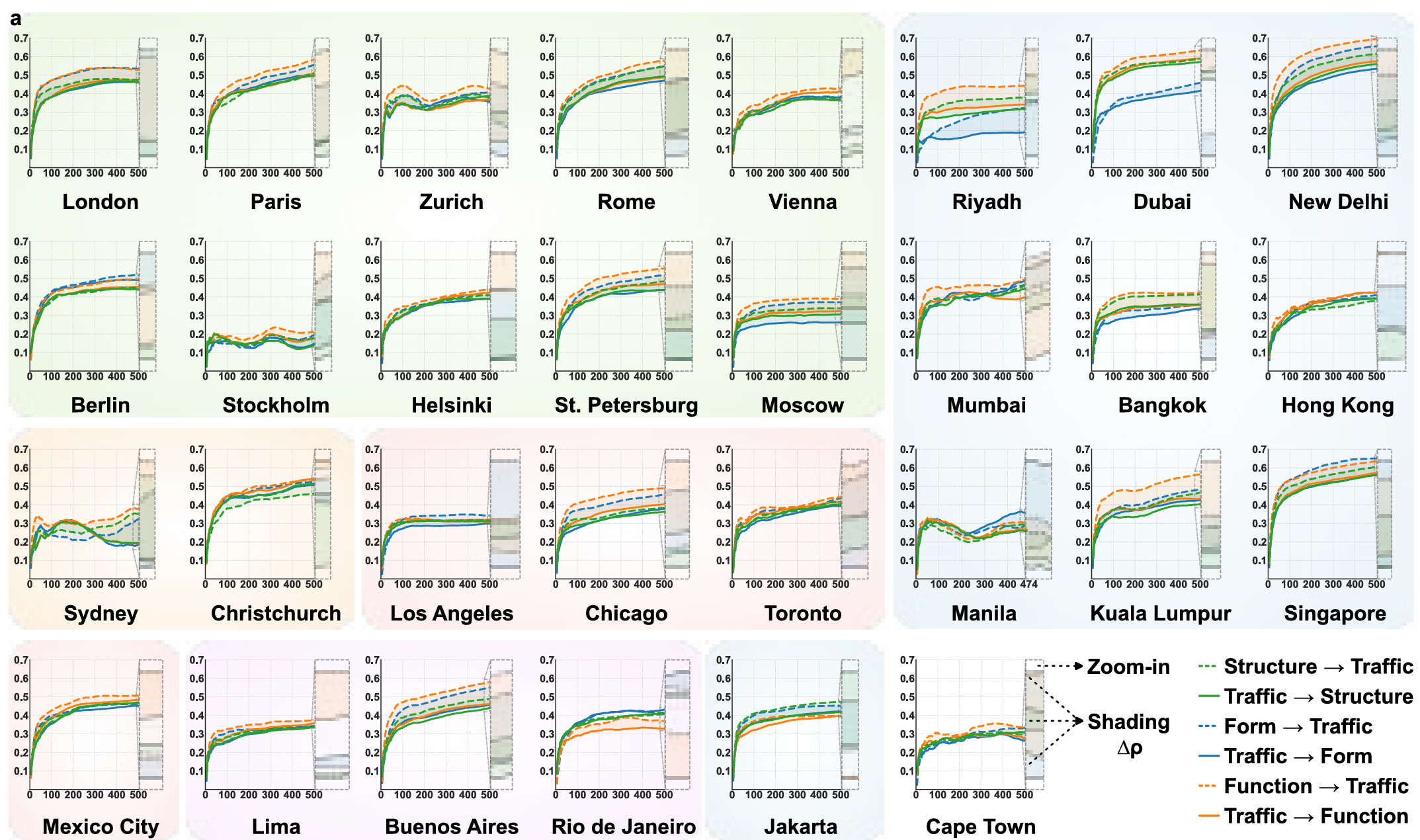
Understanding how urban systems and traffic dynamics co-evolve is crucial for advancing sustainable and resilient cities. However, their bidirectional causal relationships remain underexplored due to challenges of simultaneously inferring spatial heterogeneity, temporal variation, and feedback mechanisms. Here we present a spatio-temporal causality framework that bridges correlation and causation by integrating spatio-temporal weighted regression with spatio-temporal convergent cross-mapping. Characterizing cities through urban structure, form, and function, the framework uncovers bidirectional causal patterns between urban systems and traffic dynamics across 30 cities on six continents. Our findings reveal asymmetric bidirectional causality, with urban systems exerting stronger influences on traffic dynamics than the reverse in most cities. Urban form and function shape mobility more profoundly than structure, even though structure often exhibits higher correlations. This does not preclude the reversed causal direction, whereby long-established mobility patterns can also reshape the built environment over time. Finally, we identify three causal archetypes: tightly coupled, pattern-heterogeneous, and workday-attenuated, which support city-to-city learning and inform context-sensitive strategies in sustainable urban and transport planning.
Keywords
Developing world;
Geography;
Population dynamics;
Socioeconomic scenarios
Full Text Download
Q.E.D.