






Title: Explainable parcel-level land-use classification with geometrically grounded multimodal reasoning
Abstract
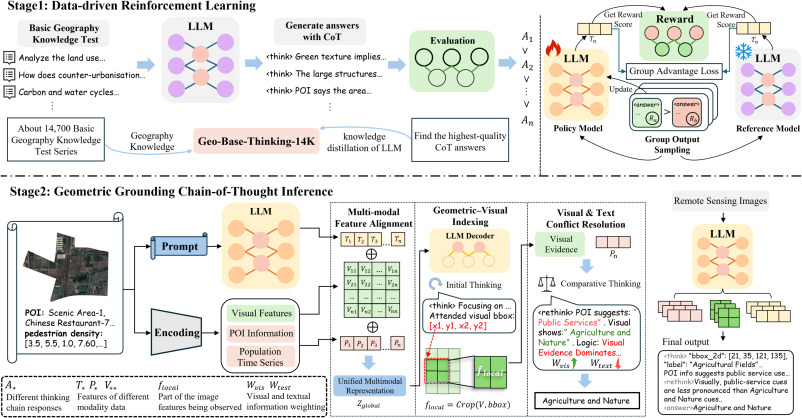
Earth observation and geospatial analysis are increasingly vital for managing urban expansion and environmental changes. However, although large vision-language models show strong potential for interpreting complex landscapes, their black-box nature and tendency to hallucinate limit their use in land-use analysis and related environmental applications. In Earth observation contexts, they often produce explanations that are insufficiently grounded in physical visual evidence. To address this issue, we present the LandAI framework, which enables explainable land-use analysis through geometrically guided reasoning. By introducing GRPO-L1, a multimodal reinforcement learning algorithm, we encourage the model to generate coordinate-based visual references via bounding boxes before producing semantic conclusions. This structured reasoning process helps mitigate conflicts between visual signals and textual priors. In the land-use sample-size comparison, LandAI achieves state-of-the-art classification accuracy with a sample budget equivalent to 25% of the land-use training sample count reported for the comparison model, showing potential for data-scarce regions. Furthermore, LandAI can help identify human label noise in large-scale datasets. Our results show that geometrically guided reasoning can improve the transparency, data efficiency, and reliability of geospatial AI for land-use analysis.
Highlight
- LandAI enables explainable land-use analysis via geometrically guided reasoning.
- GRPO-L1 generates coordinate-based visual references before semantic conclusions.
- LandAI achieves SOTA accuracy with 25% of the land-use data used by comparable models.
- Structured reasoning helps mitigate conflicts between visual and textual signals.
- Transparent reasoning chains help identify human label noise in large datasets.
Full Text Download
Computers, Environment and Urban Systems
Q.E.D.